Updated: September 2, 2026
- In response to US tariffs, Prime Minister Carney has extended existing temporary EI supports introduced last year. This includes:
- Waiving the 1 week waiting period,
- Allowing workers to receive EI without using up their vacation or termination pay
- Providing 20 extra weeks of EI for long-tenured workers.
- A new – also temporary – change will allow workers who have voluntarily left jobs are no longer penalized when they want to access EI, as long as their most recent job loss is through no fault of their own.
- While these temporary changes will help some workers, they still do not meaningfully expand EI access or increase EI benefits adequately to many precarious workers who need it most. We need comprehensive and permanent fixes to EI.
Original Article: August 14, 2026
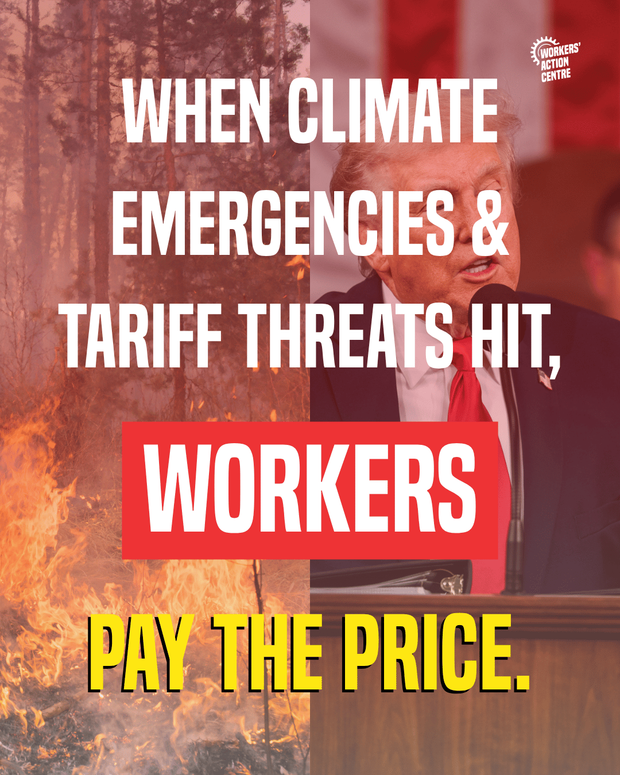
Workers who are directly impacted by climate emergencies and tariffs pay the price – along with their families and communities.
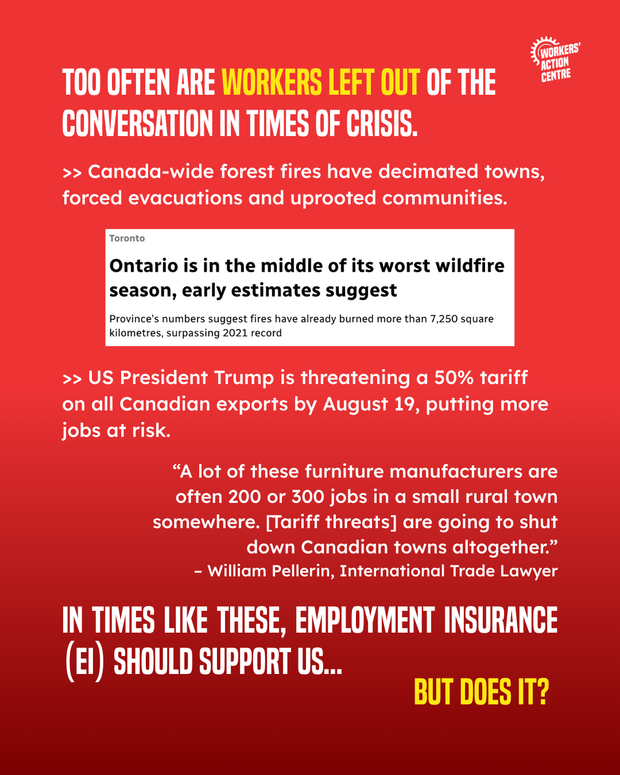
And the price is steep. For workers in Ontario and BC, wildfires have destroyed their homes, evacuated whole communities, and wiped out local jobs. Workers will be hit with even more job losses should US President Trump make good on his threat of 50% tariffs on all Canadian exports starting August 19th.
In times like these, workers should be able to rely on Employment Insurance (EI) to support us.
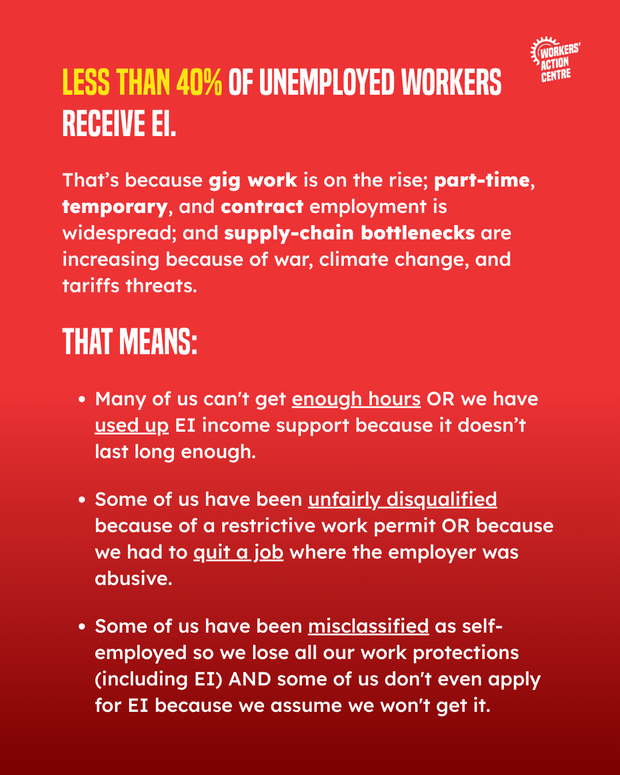
Unfortunately, less than 40% of employed workers receive EI when they need it. Despite previous emergencies like the pandemic of 2020 and the tariffs of 2025, the federal government still has not built an EI system that can carry us through our current crises.
Workers – including migrant workers – fund Employment Insurance from our paycheques, not our taxes. It should be there for us when we need it. Especially now, when Canada is burning and when tariffs are sending more shockwaves through the labour market.
EMPLOYMENT INSURANCE IS FAILING WORKERS
Why does EI leave so many workers behind? Factors like rising gig work; widespread part-time, temporary, and contract employment; and increasing supply-chain bottlenecks due to war, climate change, and tariff threats mean that:
- Many of us can’t get enough hours to qualify OR we have used up EI income support because it doesn’t last long enough.
- Some of us have been unfairly disqualified because of a restrictive work permit OR because we had to quit a job where the employer was abusive.
- Some of us have been misclassified as self-employed so we lose all our work protections, including EI, AND some of us don’t even apply for EI because we assume we won’t get it.
MARK CARNEY MUST FIX EI
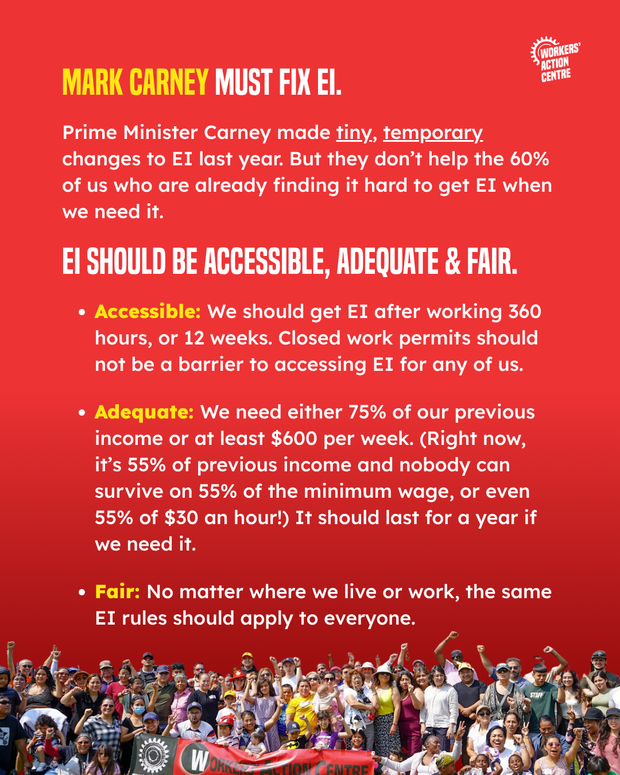
Prime Minister Carney made tiny, temporary changes to EI last year. While some reforms have helped workers who have been in stable, long-term jobs, for too many of us EI is still not available when we need it.
What must Carney’s government do to help the over 60% of us who can’t rely on EI? It’s time to fix EI by making it accessible, adequate, and fair.
EI SHOULD BE ACCESSIBLE, ADEQUATE & FAIR
- Accessible: We should get EI after working 360 hours, or 12 weeks. Closed work permits should not be a barrier to accessing EI for any of us.
- Adequate: We need either 75% of our previous income or at least $600 per week. (Right now, it’s 55% of previous income and nobody can survive on 55% of the minimum wage, or even 55% of $30 an hour!) It should last for a year if we need it.
- Fair: No matter where we live or work, the same EI rules should apply to everyone.
Workers are at the heart of every community across Canada. If we want our communities to economically survive climate emergencies and tariff wars, we need an EI system that works.