Will they really protect us?
There has been a lot of talk about the new rules for employers when they are posting jobs and hiring workers in Ontario.
Let’s look at these new rules and see if workers are better protected. In our experience at the Workers’ Action Centre, any new protections need to go hand in hand with real enforcement and strong consequences for breaking the law.

There are 5 changes to Ontario job postings.
These new rules apply to any publicly-advertised job listing posted by an employer with more than 25 employees.
1. Salary must be listed
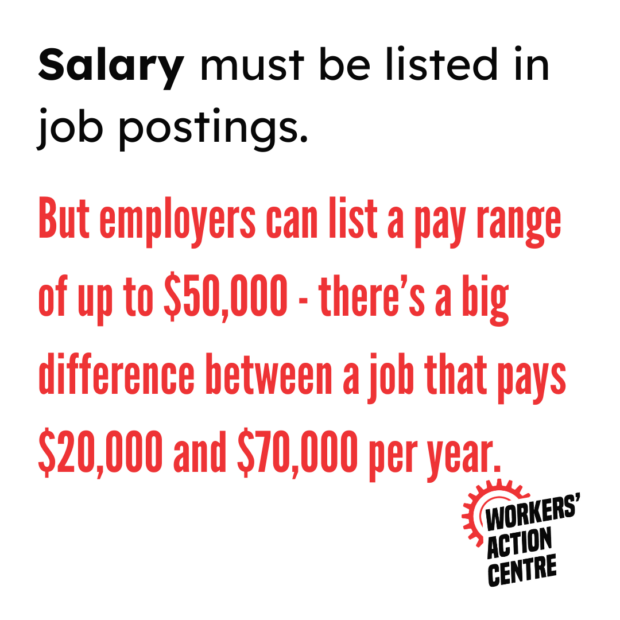
NEW: Employers need to include the job’s rate of pay or a pay range in every job posting. This pay range cannot be larger than $50,000.
- First of all, a $50,000 pay range is too large. There is a big difference between a $20,000/year and a $70,000/year job.
- Nothing in the law requires the employer to offer you a job within the compensation range in the listing. In other words, while an employer must include a wage range within the public job posting, they do not have to offer you that wage if they hire you.
- Did you know that back in 2018 the previous Ontario government had passed the Pay Transparency Act which had much stronger rules forcing employers to be honest about how much they were paying employees. This would have helped with pay equity and addressing the racial and gendered wage divide between workers. But when the Ford government came into power, they blocked the implementation of this important new law.
- Also in 2018, we had “equal pay for equal work” legislation. That law made employers pay the same wages for the same work as a way to address the rise of part-time, contract and temp work. Sadly, this was only in place for 8 months before the Ford government got rid of it.
2. Canadian work experience cannot be required
NEW: Employers cannot require Canadian work experience or Canadian education in their job postings.
- Discrimination based on citizenship is already illegal according to the Ontario Human Rights Code. Of course, it’s important that now our labour laws reflect the same rule. But what do workers do if they face this discrimination during a hiring process? If you want to file a human rights complaint, you will be faced with a multi-year process because of the huge backlog of cases.
- Workers also cannot file anonymous complaints with the Ministry of Labour which means that the employer would find out. This could jeopardize any future prospects with that employer.
- Therefore without real enforcement, workers still will not be protected from this discrimination at every stage of the hiring process.
3. Employers must provide a response after an interview
NEW: Employers must now contact every person they interviewed for a job within 45 days of the interview to let them know whether they were hired.
- 45 days is still a long time to wait for an update. And employers still do not need to respond to applicants that they did not interview.
4. Job postings need to say if there are actual vacancies
NEW: A job posting must include whether it is for a current vacancy so workers know whether there is an actual job available when they apply.
- Even if employers post that there are real vacancies, the law does not require them to actually fill that available job.
5. Job postings must state if they use AI
NEW: Employers must include a statement if they are using artificial intelligence to screen or select candidates.
- Employers do not need to include any details of the AI system or how it will be used. These new rules do not prevent or limit the use of AI.
- As a result, this provides very little protection for workers. It basically requires employers to admit that they are using AI without any way to enforce fairness and protections.
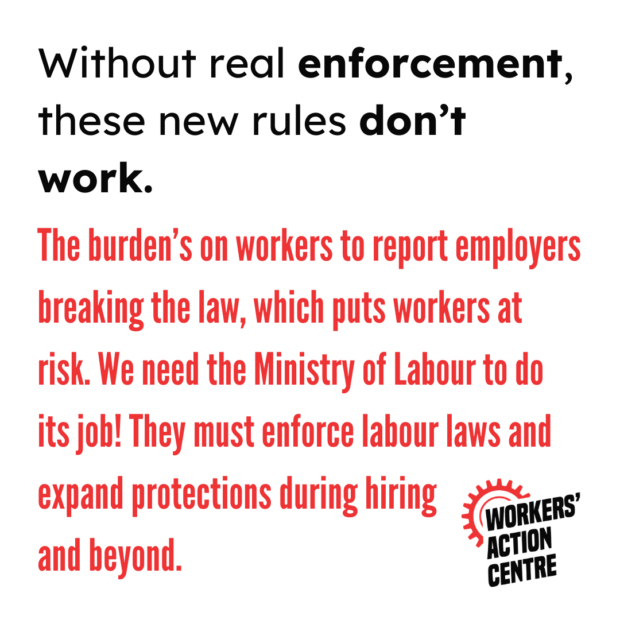
If the Ontario government was “Working for Workers”, we would have stronger enforcement of our basic labour laws.
It is clear that these new rules are completely inadequate in protecting workers throughout the hiring process. The real problem that needs to be addressed is an enforcement process that depends on workers to file complaints. The government is relying on workers to identify problems and report them, which takes time, energy and potentially jeopardizes their employment.
It is unfair to expect workers to be the ones identifying and reporting job postings or hiring processes that do not follow the rules, especially without any protection for doing so.
That is why the Ontario government must better enforce violations to the Employment Standards Act by taking proactive steps like hiring more Employment Standards Officers and doing inspections rather than relying on workers to do their job for them.
Our Wage Theft Campaign demands just that: Better enforcement and protections for workers at every stage of the process. To learn more and join the movement, check out the Wage Theft Campaign!