#1 You are never given a paystub
Did you know that all Ontario workers must provide a pay stub on or before your pay day? Pay stubs must include things like i) what was the pay period ii) what is your gross wages and how it’s calculated, iii) what was deducted and why were they deducted, and iv) your net pay.
Many of us do not receive pay stubs when we get paid. This is illegal. Your boss might not be providing you with it to hide the fact that they are not paying you for every hour you worked. Or they might be deducting too much from your pay and claim it is for taxes. Without a paystub, this is hard to spot.
If you do not get a paystub you should immediately start documenting your pay. For example, if you received payment in cash, you could text your employer to confirm the total amount of money you received and your hours worked. You could also save a copy of the text or email where you received an E-transfer deposit.
#2 You have no contact information for your boss
If you are offered work by anyone, try to get the legal name of the employer and any other business names they use. You should also find out your employer’s contact information, such as full name, address, phone number, websites and email. (Did you know that if you work for a company who employs 25 or more workers, they are legally required to provide this?) And if you are taken to different job sites to work, make sure you take a picture of the workplace and document each address.
In our experience, bad bosses will try to disappear when workers are trying to get them to pay unpaid wages. These bosses will only give you a first name or a nickname and a phone number. Or they might give you different names or fake company names so you do not know who you are actually working for.
If your employer does not give you their contact information, start collecting as much information as you can while you are on the job. For example, you can find out the name, address and contact information of your supervisors, take photos of the company’s license plates, or write down the addresses of all the places you are sent to work.
#3 You never signed an employment contract
Many of us do not get an employment contract when we start work or we only have a verbal agreement for wages, hours and start date. Sometimes we are asked to sign something or are shown a contract but the boss does not give us a copy.
Bad bosses will do this so that they can scam you out of wages. In our experience, bosses deliberately make contracts verbally to pay you less than what they promised. Some will even pretend they do not know you and deny that you even worked for them.
If you do not get a written contract from your boss, make sure you document texts or emails confirming details such as hourly wage, hours, job duties, start dates and pay schedules. For example, you can send a text or email saying, “Looking forward to working with you John. I am just confirming that I will get paid $22 an hour, I will start on May 1 at 8am and I will be working a 45 hour week with you.” Even if you do not have a written employment contract, documenting your actual pay and working conditions is useful.
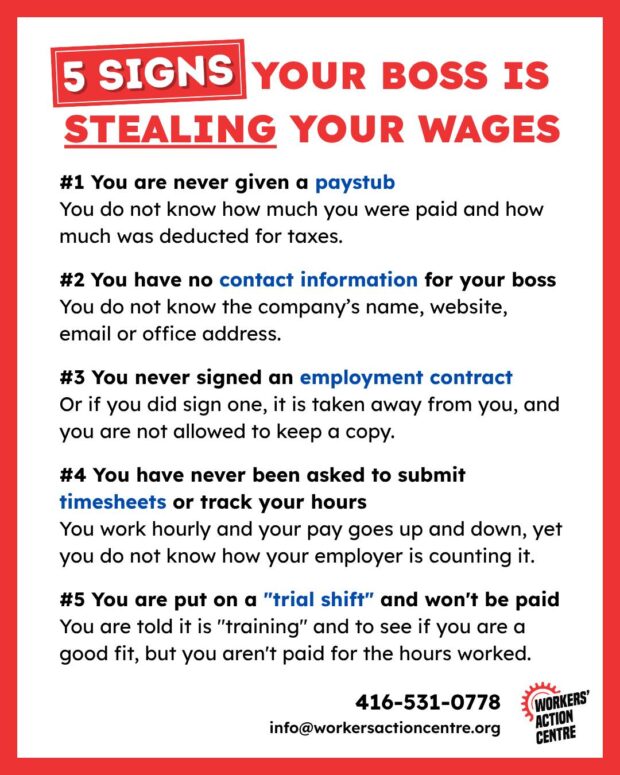
#4 You are paid per hour, but you never have to submit timesheets tracking your hours.
Documenting the hours you work is important in challenging wage theft. Without an accurate log of hours, how will you know you are being paid overtime? Or that you are paid for when you had to come in 30 minutes earlier to set up, and had to leave 30 minutes later to clean up?
If you do not submit timesheets, keep an accurate record of the start and end times for each working day. And if your boss asks you to come in earlier or stay later, write it down or save the text message. In our experience, bad bosses do not want you to accurately track your hours so they can get away with paying you for fewer hours
And even if you do submit timesheets, make sure you make your own copies of them. Sometimes hours worked are recorded on a calendar or note book in the workplace. And once you leave the job, you cannot go back in to see it. Or sometimes your hours are logged on a website your company uses and they delete your account once you leave the job. Take copies such as screenshots or photos of your time sheets.
#5 You are told you are on a “trial shift” and won’t be paid
Many of us desperately need work right now. As a result, we can easily be taken advantage of by employers who make a lot of promises. For example, some bad bosses will promise they will hire you but need you to do a “trial shift” first that will not be paid.
Unpaid trial shifts are illegal. If you work, you need to be paid for your time. If training is required to do the job after you are hired, you need to be paid for your time. For example, if in a restaurant you are serving tables, cooking and cleaning, you must be paid for all that time. It does not matter if they call it “training”, a “trial shift” or “probation.”
As soon as your boss tells you they are not paying you for your training, make sure you begin documenting everything. As mentioned in the 4 signs above, this includes contact information, working conditions and hours of work.
If your boss did any of these 5 things to you, they might have been stealing your wages! So if you have any questions about wage theft, call us on our free and confidential phone line at 416-531-0778 to find out what to do.